Backstories and Backyards: Distilling
This month’s column examines just what might be found in a half-gallon Mason jar by way of three such glass canning jars in the Old Church Gallery cultural arts collections.
By Kathleen Ingoldsby
“Backstories and Backyards” looks back into the stories behind everyday objects, connecting each item with the people, places, and events of different eras in Floyd County history. This month’s column examines just what might be found in a half-gallon Mason jar by way of three such glass canning jars in the Old Church Gallery cultural arts collections.
During the 19th century, there were respectable distillers of every stripe and color operating in Floyd County. Apples, corn, sorghum molasses, rye, peaches, berries, and barley for spirits and even pine products for turpentine were distilled. Chataigne’s Virginia Gazetteer and Classified Business Directory, 1888-1889, lists 29 registered distillers, and by 1893-1894 the numbers had increased to 42, located in just about every part of the county.
Regulatory policies often governed distillery operation. A 1791 federal whiskey tax, in place until 1802, led some distillers to make whiskey in secret to avoid paying taxes. This led to night time smuggling and, in Pennsylvania, the very earliest use of the term moonshine in the U.S.
The first print mention of moonshine is found in the 1785 London dictionary of Francis Grose describing “the white brandy smuggled on the coasts of Kent and Sussex,” England.
Economic conditions and downturns could also prod small distilleries to produce their product under the radar. When farm finances were tough, distilling alcohol might help provide for one’s family. Costs of Civil War strife caused permanent reinstatement of the federal tax, putting another burden on already distressed wartime farms.
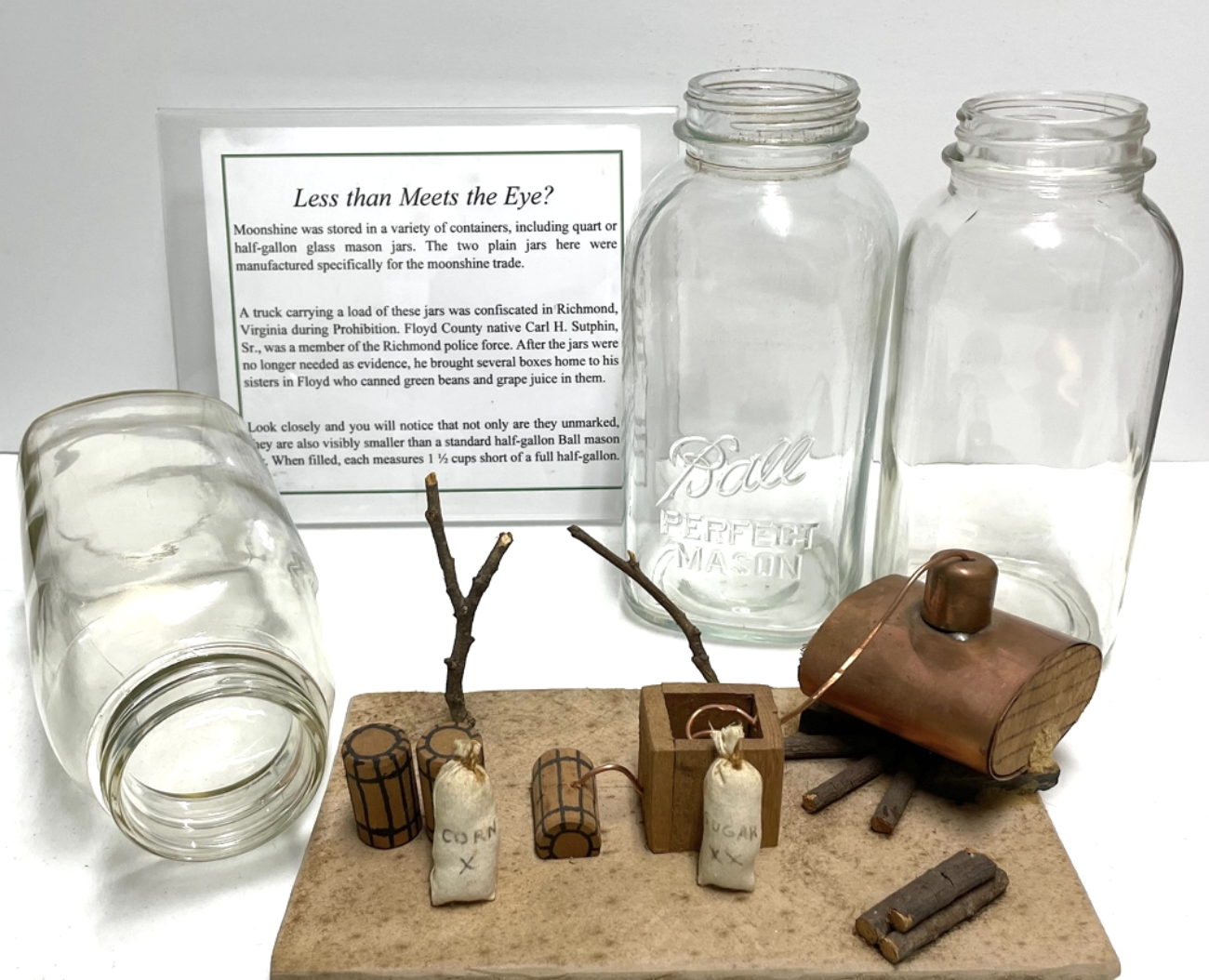
Moonshine was stored in a variety of jugs or containers, including quart or half-gallon glass mason jars. The two unmarked jars shown here were manufactured specifically for the moonshine trade and, unlike the well-marked Ball Perfect Mason jar, were about 1.5 cups shy of a true half-gallon!

Our store offers a selection of lumber, roofing material, insulation, plumbing fixtures, electrical components, and conveniently located five minutes outside the town of Floyd.

Castillo Construction of Floyd offers trusted home renovations—kitchens, baths, flooring, decks, and repairs. Real projects, family-run, and detail-focused. Serving Floyd and surrounding areas. Se habla español. Call or text anytime: 336-988-6899 (Español), 336-988-6992 (English).
Local. Reliable. Done with care.
A truck carrying a load of these jars was confiscated in Richmond during Prohibition. After the jars were released from evidence, Carl H. Sutphin, Sr., of the Richmond police force, brought several boxes home to his sisters in Floyd, who canned green beans and grape juice in them.
In the early 1900s, apples were commonly used to make brandy, as Effie King Brown explained in a 1993 talk to the Floyd County Historical Society:
Effie King Brown: Our huckster was Mr. Sam Vest, our neighbor, who usually came in the late afternoon on Wednesday, or early Thursday morning. He was driving his load, going to Roanoke to sell for the weekend. And he would take all the odds and ends that you had to sell. Frank E. Brown (market merchant) bought all these things. He stayed in business a long, long time in Roanoke.
He bought the dried apples, and the dried berries, and the dried cherries too. And these were sold to the distiller to be made into brandy. Little did my mother know that her dried apples were going to be made into brandy or she would never, never in this wide world, have dried those! But that was really what was done with the dried apples. And the apples that were not so juicy were the best to dry; the best ones to dry were the York and the Ben Davis.
Distillation was first used to produce perfumes in ancient Mesopotamia. The process evolved over centuries and, by 8th century Arabia and 12th century Italy, included the distillation of alcoholic beverages. Earlier, in ancient Greece, the turpentine distilled from pine resin was essential for weatherproofing and preserving wooden ships.
In American history, early Native American tribes were among the first to use the resin from pine trees for medicinal and practical purposes--as an antiseptic, insect repellent, and in the construction of canoes.
During his 2001 interview, John McNeil told Brian Hill, Radford University Anthropology Department student, how he used pine resin left over from distilling turpentine for grafting apple trees:
John McNeil: Well, my grandaddy and my daddy, they done grafting and they liked it. I just sort of took it up on my own. I ordered books about propagating plants and things.
Brian Hill: So, do you have to use a special kind? I’ve heard of grafting wax. How do you use that and what’s that used in? I’ve never done any of this.
John McNeil: Well, the wax I use is what they call a cold wax. Got to be warm weather before you can work it. And they have hot wax, but I always just used cold wax. You mix three ingredients together. What they call English rosin, left over from distilling turpentine, beeswax, and beef tallow. Mix it in with, I think about four parts rosin or one part beeswax. Now, tell you what. I’ve made the wax itself, but it’s got to where I don’t know where you’d find that rosin anymore. Although, country stores used to sell it years ago. I take rosin sort of like they used to rub the bows with for the fiddle.
Medicinally, whiskey has long been used as an antiseptic and as a treatment for respiratory infections, as Vada Hylton explained in a 1999 Buffalo Mountain place-based interview:
Vada Hylton: The only thing that Dad ever used for medicine, we all had the flu one time, and the twins and brother and I were coughing our heads off. And Dad called Dr. Harman here, he was a cousin of my Grandpa’s. He was a doctor, Jabe Harman, here in Floyd. My daddy called and said, “The kids is about to cough their heads off.” Says, “What must I do?” He said, “Go to the store and get you some rock candy, fill you a glass full of rock candy and then pour whiskey on it.” Dad says, “Lord a mercy, where am I going to find any whiskey?” He said, “Well, get your neighbors, some of them out there in the Buffalo will get it for you.”
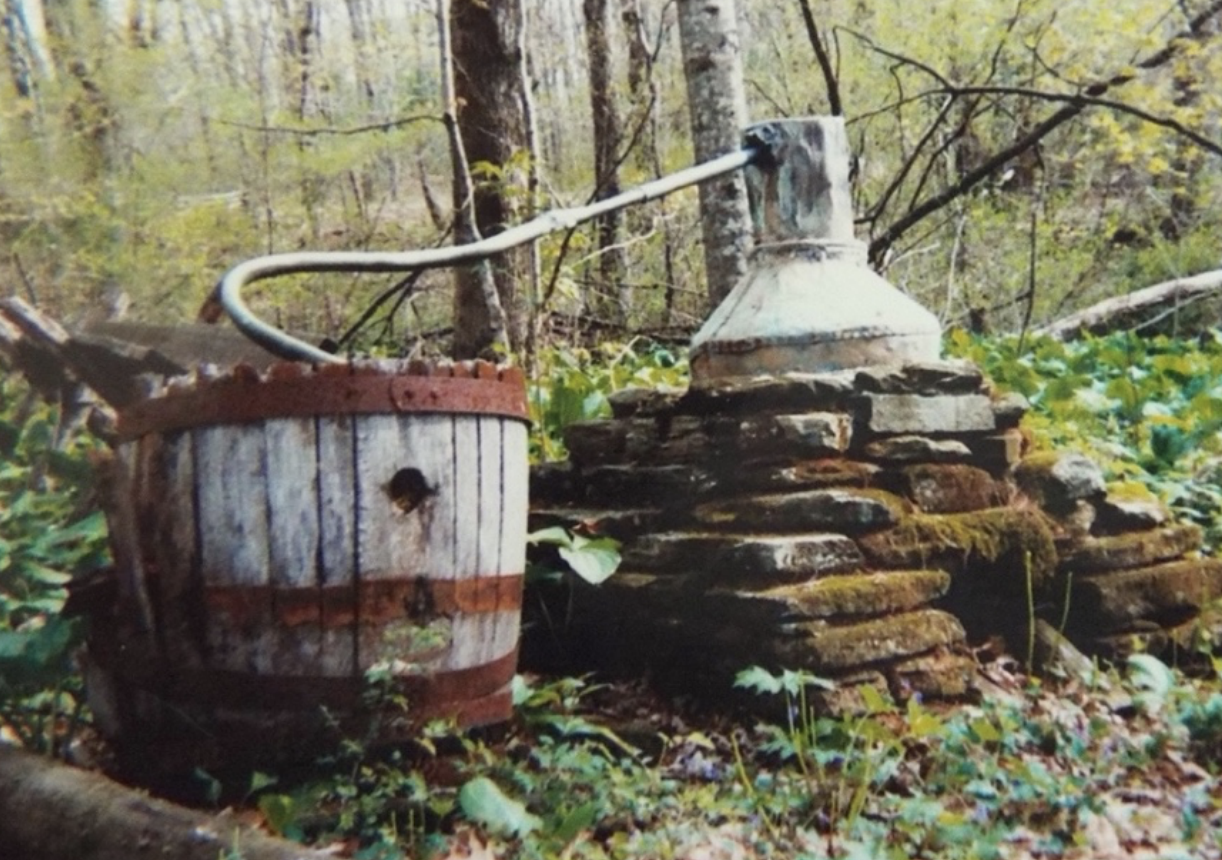
And there just happened to be a number of moonshiners in the Buffalo Mountain neighborhood. In 2000, Ruby and Stanley Lorton shared their recollections with Radford University student Julian Alleyne, as part of the Buffalo Mountain place-based interview series:
Ruby Lorton: When we were growing up, they used to, a lot of them made liquor, and they had stills, made liquor, a lot of people did.
Julian Alleyne: Moonshine?
Ruby Lorton: Oh yes.
Stanley Lorton: I worked with a fellow one time; he used to haul it [moonshine] in a Model-T Ford. He used to haul so many gallons, five-gallon tin cans. See, they didn't have the roads we got now, going over some of these high ridges and steep hills, the old Model-T Ford that didn't have a full tank of gas wouldn't get it to the carburetor, wouldn't get up the top of the hill. He told me he would have to turn around and back up many a hill in that old Ford [laughing] to get it up over the hill.
Ruby Lorton: They had plenty of apples and grapes, and that's what they made it from.

We offer locally sourced, insect and rot resistant hemlock, and lots of other species for just about any project.
We also can provide firewood, kindling, mulch, sawdust, and shavings.
Inside we produce paneling and flooring in various, often rustic local woods.
Come by or call Stacy
276-692-8754
During his 2015 WWII-era series interview with Floyd County High School student Luke Moran, McCrey Shortt provided a wealth of stories, photos, and letters about his WWII Army service. He also filled us in on stories from his youth and how to make moonshine.
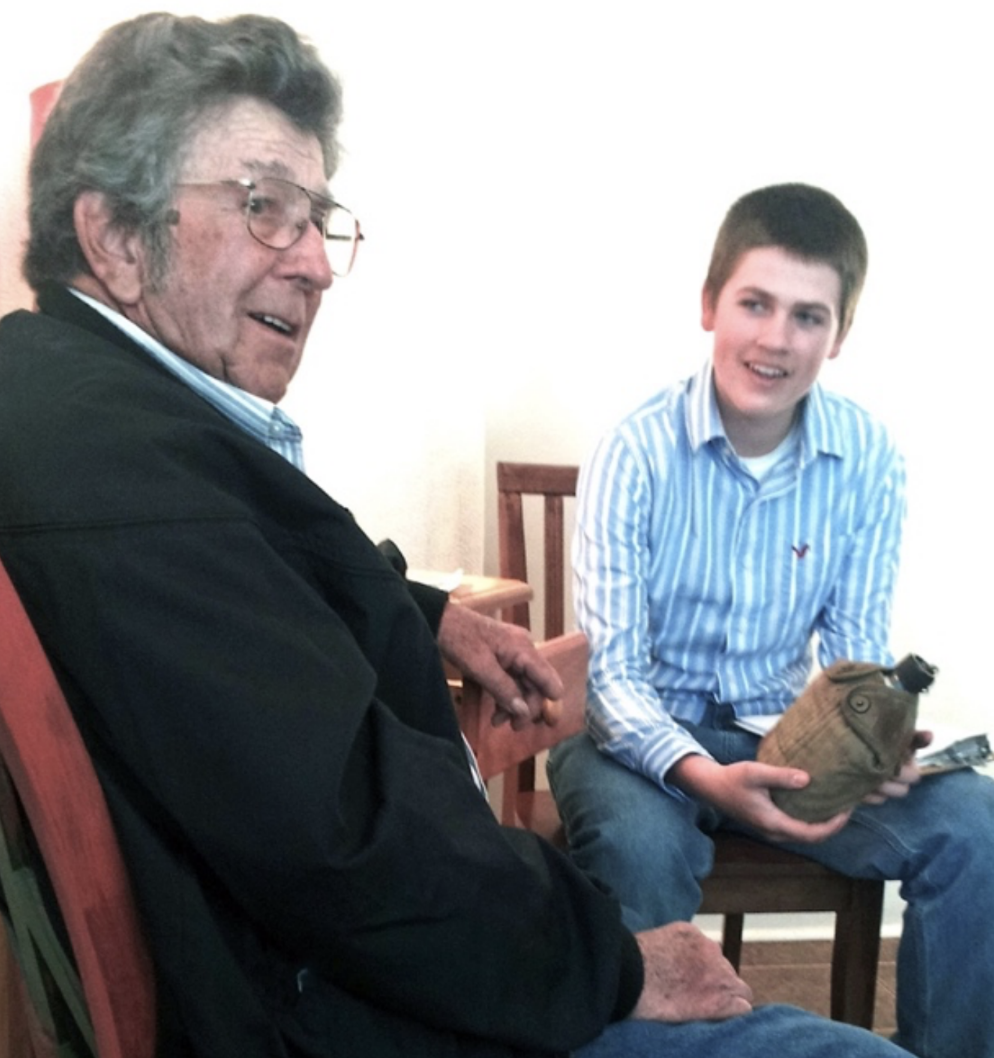
McCrey Shortt: Well, when you made the regular moonshine you used corn, cornmeal, and pour it in boiling water. And let it sit so hot ‘til you can run your hand around in the bottom of it, and you put sugar in it then. Back then, there wasn’t no sugar, you put karo syrup in for sugar. Then you’d get to where you run your hand back through it, and it was ready to go then. And then mash it, let that still run it down, and you’d always catch the first cup full and drink that! The connection between the miller's trade of grinding grain and the distiller's need of it, creates an interesting dynamic, well described in “The Water-Powered Mills of Floyd County, Virginia” (Webb and Cox). Judging by the number of legal distillers, 1880-1900, in Chataigne's Virginia Gazetteer, with names that also matched grist mills here, distilling seemed a reasonable sideline.
Oral history from Henry Earle's daughter related that her father (Henry Harrison Earles 1840-1923), who operated a mill near Beaver Creek, made apple brandy and possessed a legal tax stamp. Leonard Booth recalled that the Earle's upper field was full of apple trees.
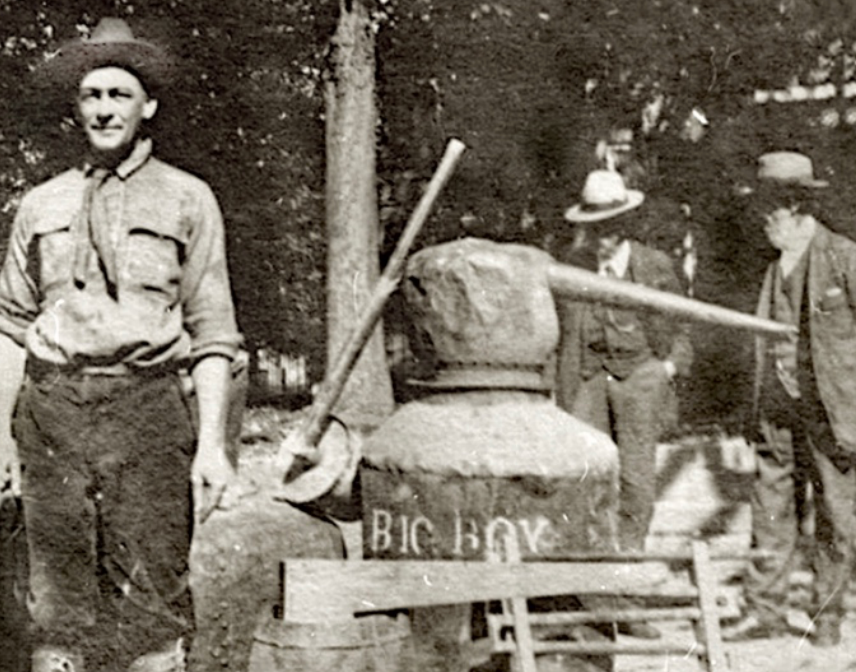
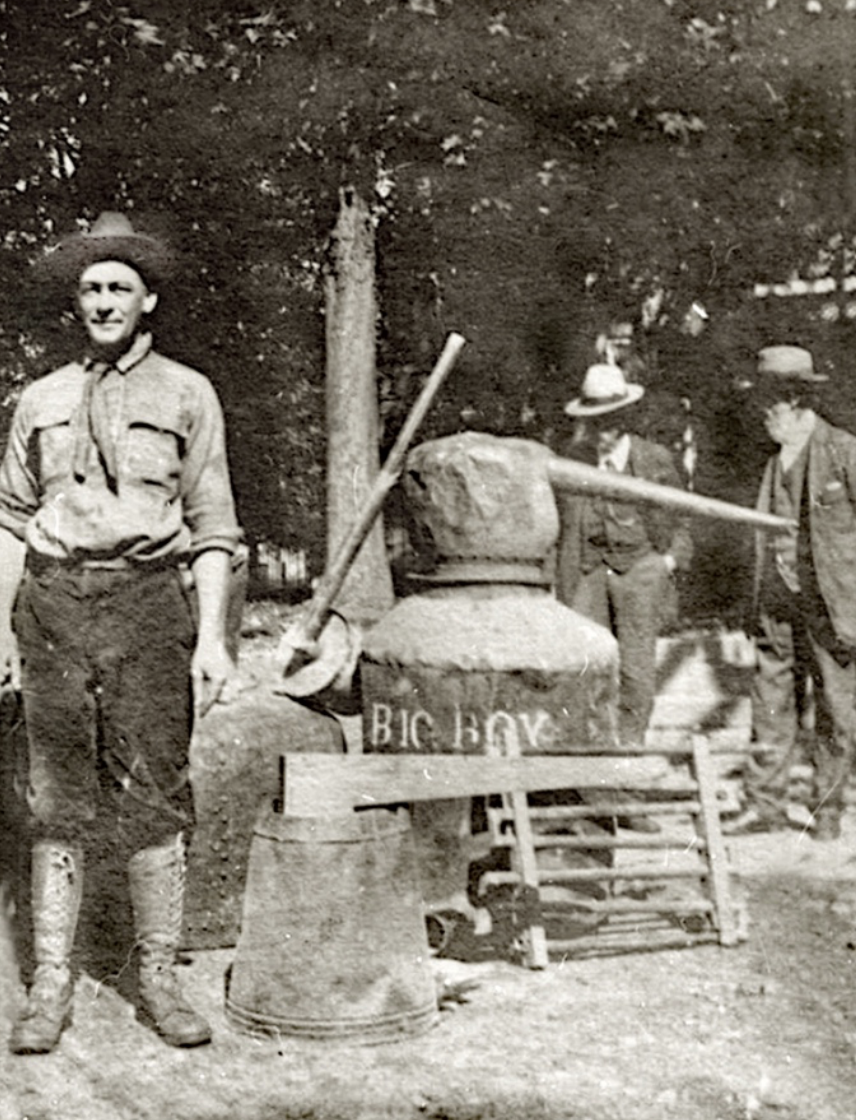
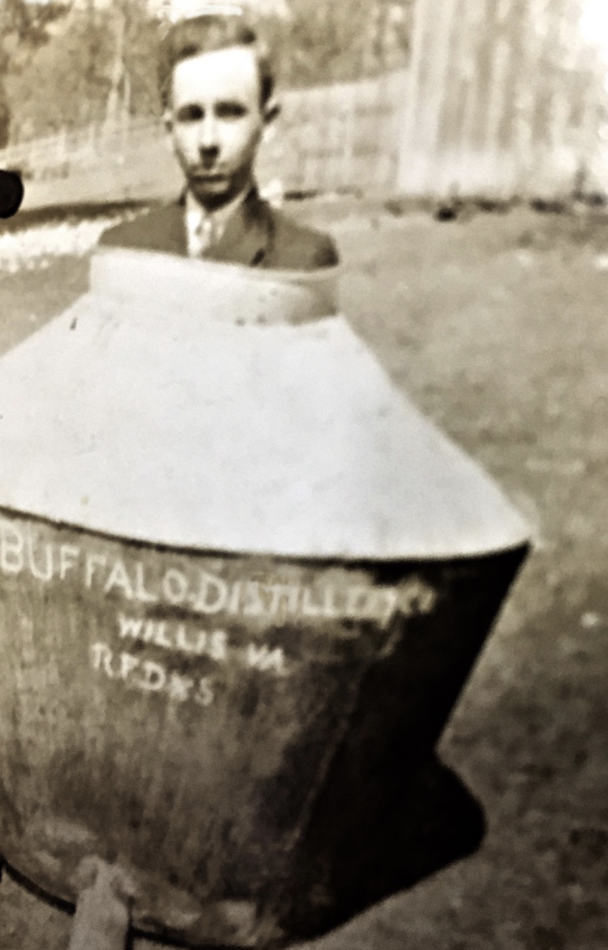
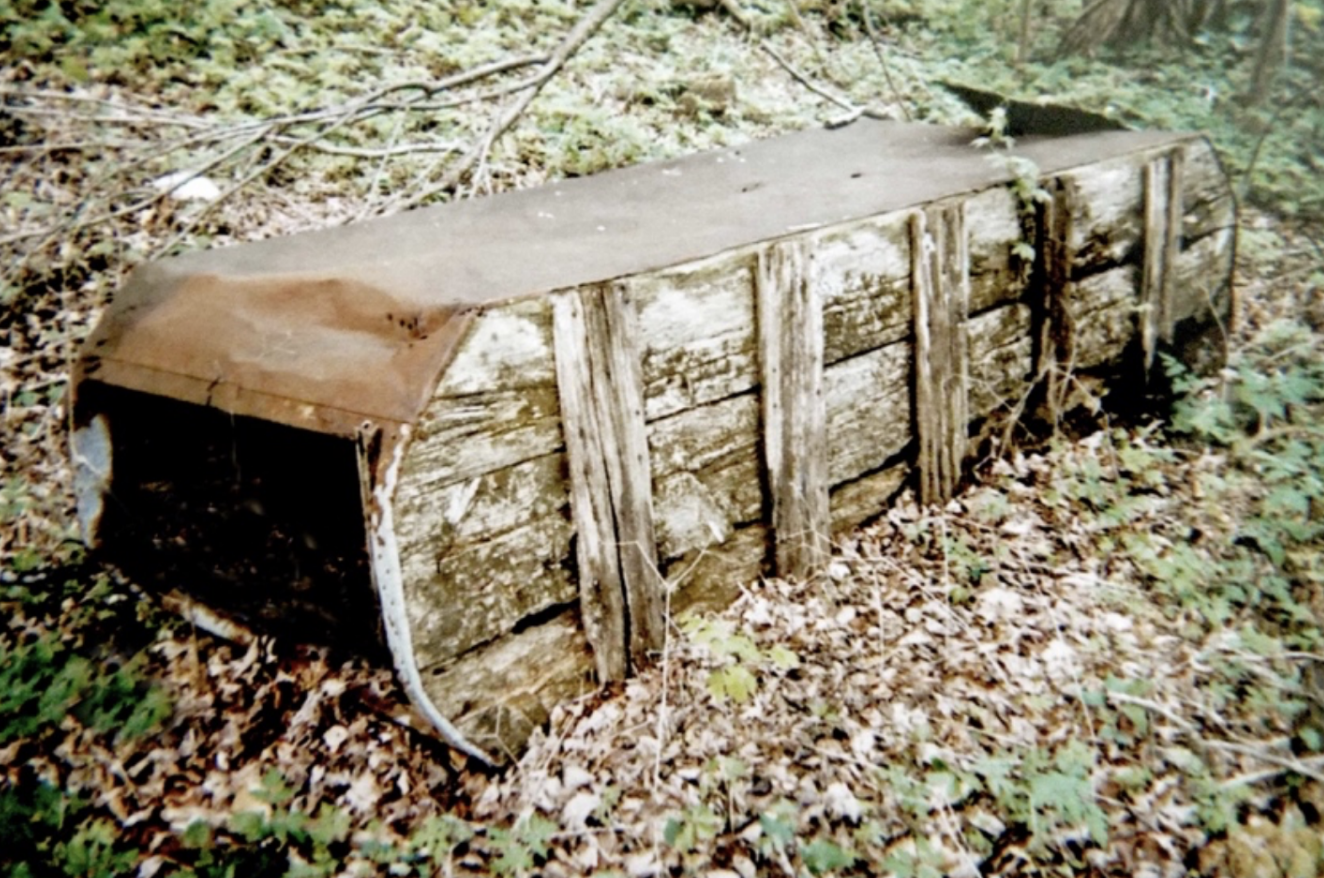
Easily constructed of boards and sheet metal, the submarine-type still came into popular use by the 1920s through Prohibition, replacing the 18th-19th century classic turnip top, copper still. The general principle of distilling – boiling fermented mash and then cooling the steam back into a liquid – is the same for the submarine still as it is for the turnip top still.

Today, Floyd County’s first distillery since prohibition is in business. Five Mile Mountain Distillery produces legal Moonshine products based on early recipes and distills its spirits using traditional, though very much improved, copper stills.
When asked how times have changed, Frank Hancock told of another well-crafted copper still during his Community and Neighborhood series, 2017 interview with Floyd County High School student Marie Ledbetter:
Frank Hancock: Well, there seems to be more opportunity for employment in the county than there was before. Back in those days, you’d either work for the highway department, you farmed, or did logging, or you did moonshine. I’ve known all my life that my father had been involved a little bit in making moonshine. It took me until, I guess about the time that I retired, to fit some pieces together to know the story.
I had a cousin that got back from the Second World War, and he was management for Norfolk and Western Railroad. Apparently, men in management had expressed desire for some moonshine, good moonshine. So, my cousin had come to Dad, and said, “Okay, I’ll supply the still, and handle the distribution, if you make it.” So, money being tight not long after the war, Dad agreed to it, but he got busted as soon as he made his first run, which was good. One of the things I’ve always heard that never really made sense was that when they broke up Dad’s still, that they didn’t blow it up or chop it up with axes like they did most of them. They brought it up and put it on the courthouse lawn here at Floyd for people to see, because it was such a work of art. It was built in the Norfolk and Western Railroad shops, and those boys built steam engines. It was all copper and brass, and it was just gorgeous.
Another of our WWII-series interviews was with Burnett Marshall, conducted by high school student Zach Newland in 2012. Mr. Marshall told us a poignant story that concerned yet another half-gallon mason jar.
Burnett Marshall: Yes, I’ll tell you a story on that. Just before Christmas, this was in ’43, they called me in, told me my mother was real bad, and he’s going to give me a 10-day leave. So, I caught the train and come home, and she had double pneumonia. We didn’t think she was going to make it, but she pulled out through it, and I think it was the fifth day before she knew I’d been home. So, I had a few more days there, and I had to go back the day before Christmas. So, it’s kind of sad I had to leave, and it kind of hurt me.
Well, I may as well tell this too. My brother was there, and he took me over to Christiansburg to catch the train and he grabbed my bags. He had to carry it for me. So, I didn’t get a hold of my bags until he started up the steps on the train. And I didn’t give it too much thought going down through there until about West Virginia, started hitting those tunnels. I had it dawn on me that there’s something in my bag; I better check it.
So, I opened the bag up and he had a half a gallon of moonshine liquor in the bottom of it. So, I didn’t want to open the fruit jar up and start drinking it in front of everybody in the car. I didn’t know how they would feel about it. I started drinking on it, sipping on it. But I had to go to the restroom, and I would always carry my old duffel bag with me. I guess people began to wonder why a guy carries that duffel bag with him every time he goes to the restroom. But they had no idea what I had in there. I still had some left and we got to Camp McCoy, and it was pretty sad around there during Christmas — just a few of us. But that made it a little bit of lively!
We certainly don’t know if Burnett Marshall’s fruit jar was imprinted as a “Ball Perfect Mason” or if it was unmarked and 1.5 cups short. But given the circumstances, it’s hoped that the troops at Camp McCoy enjoyed a full quotient of cheer that Christmas day in 1943.
Note that both the Floyd County Historical Society and the Old Church Gallery are listed on Virginia’s Mountain Spirit Moonshine Heritage Trail, located in the counties of Floyd, Patrick, and Franklin. Travel the trail, and to learn more local moonshine history see Charlie Thompson’s recent book, “Spirits of Just Men.”
All Floyd Story Center interview excerpts are courtesy of Old Church Gallery in Floyd. The excerpts presented in this column represent a larger archive of over 120 interviews, 1980s-2024, many recorded with both audio and video.