FloydFest achieves 41% waste diversion rate
Nearly 27,000 pounds of material left FloydFest for recycling and composting centers, according to the festival's waste contractor, Zero Waste Event Productions (ZWEP). That compares to 41,500 pounds of material sent to the landfill.

FloydFest generated tons of trash while hosting thousands of patrons in Check for the July festival. There were oily pizza boxes and carry-out clamshells left over in the food court and countless cans and plastic containers emptied of beverages.
Heaps of moist, used paper towels discarded at the bathrooms added to the total, as did vendors’ refuse and assorted odds and ends associated with setup and breakdown of the event.
But rather than dump all the waste, FloydFest turned to waste diversion — putting items where they’ll do the least harm through composting, recycling, and donation. The efforts reduced the amount of trash sent to the landfill by more than a third, according to a new report.
Nearly 27,000 pounds of material left FloydFest for recycling and composting centers, according to the festival's waste contractor, Zero Waste Event Productions (ZWEP). That compares to 41,500 pounds of material sent to the landfill.
Environmental consciousness has long been part of the festival’s identity. Paid staff and volunteers, with help from cooperative patrons, strived to capture every tossed pizza crust for a company that makes compost and snagged beverage containers for shipment to a recycler. Trash crews worked sometimes until midnight.
“Our green is our gold,” Sam Calhoun, an executive at Across-The-Way Productions Inc., which produces FloydFest, said in a prepared statement. One goal of festival organizers is to limit “our environmentally-negative footprint,” he said.
Family-owned HVAC installation and services.
25 years of experience. Committed to excellence.
Financing available with approved credit.
540-745-4912
436 Floyd HWY S
Zero Waste, a private company in the business of festival waste management, was a key player. Based in The Plains, Ohio, the company provided personnel, equipment, supplies and systems for collecting and sorting the waste as the bands played.
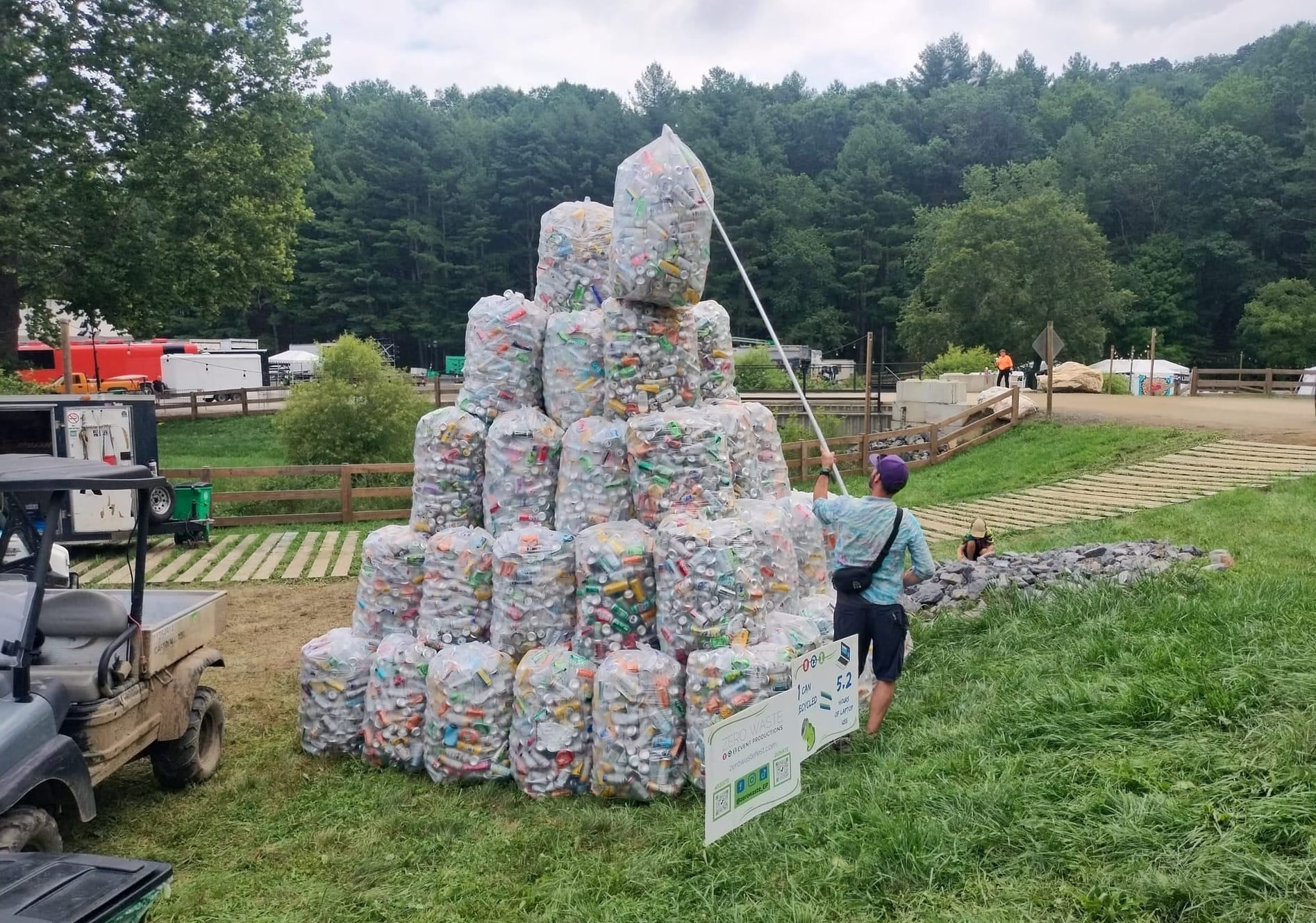
At the beginning of the waste stream, patrons dropped their discards at bag stands marked "RECYCLABLES," "COMPOSTIBLES," and "TRASH ONLY" spread throughout the event space. Crew members in four-wheelers hauled the filled bags to Zero Waste’s operational hub at Festival Park, a small clearing off to one side of the Main Stage, beside a fenced stream. Festival goers could spot the trash center by a stack of bagged aluminum cans that grew many feet tall as the festival wore on — a beeramid.
Working under a white canopy, crews opened and emptied the filled trash bags onto a conveyor to hand-sort the contents into five main non-trash categories. The results, over five days, were as follows:
- Compostable foodstuffs and paper, including paper towels: 11,198 pounds.
- Cardboard: 8,200 pounds.
- Plastic, glass, and tin: 5,000 pounds.
- Aluminum cans: 1,980 pounds.
- Scrap metal: 450 pounds.
In addition, some material that was considered diverted never entered the physical sorting operation. Zero Waste Event Productions also counted an estimated 1,298 pounds of beer cups and water bottles not needed because of the use of refillable vessels, and 1,400 pounds of edible food given to a food pantry, for a grand total of 29,526 pounds kept out of the landfill.
Sorting trash this way is messy, dirty work. At the edge of the conveyor belt, volunteers trading their labor for festival tickets worked alongside ZWEP regulars to process a small mountain of incoming refuse bags. Each time a bag was dumped for sorting, the items emitted telltale odors like cigarettes, alcoholic beverages and wet cardboard.
At one point, someone lit a stick of incense to mask the smell. Halves of lemon plucked from the waste were used to wipe down and freshen the belt every so often.
“The biggest eye opener of this experience is just how much goes on behind the scenes in waste and waste reduction,” said Quin Campbell, student at Virginia Tech from North Carolina who volunteered along with a friend and fellow student, Lily Warco of Alexandria.
“This experience has really opened my eyes to how much waste we [generate], like small pieces of plastic that I would never think of before that have to be hand sorted,” Warco said.
Computed against the landfilled trash, FloydFest's diversion rate was 41%.
UPDATE- Floyd location is now closed
Southwestern Virginia’s premier source for hemp products. From edibles and tinctures to topicals and accessories, we provide trusted, high-quality options for both wellness and relaxation. Visit our retail location in Roanoke (Wasena neighborhood) or shop online today!
Tyler Bonner, Zero Waste’s founder, cautioned that the total for landfilled trash includes items that were in dumpsters at the festival site before the festival began, indicating that the computations aren’t an exact science. In addition, the many campers spread through the festival site contributed trash that in some cases went directly to the dumpsters. Finally, rainwater from storms that passed over the event added to weights, Bonner said.
“The ultimate goal of our operations is to help events work toward a 90% or higher diversion rate... which we have achieved with a handful of partners. It can be a bit trickier though for camping events specifically,” he said.
At 41%, FloydFest exceeded the average diversion rate for regional localities. Regional localities as a group posted a diversion rate of about 28% last year, according to Joe Levine, who directs the New River Waste Authority.
“Great job,” said Levine, whose organization supports recycling and separation of materials to extend landfill life.
The efforts are “something very positive for our community,” said Jackie Crenshaw, president of Sustain Floyd. “I take my hat off to them.”
Think of the money saved, she said.
According to the waste authority, the disposal of 41,000 pounds of material would have incurred a $700 fee paid to the landfill. Not dumping some 29,000 pounds of additional material saved $500, Levine said.
Jonah Geschwind of Green Disco, a New York company that supports environmentalism at live events, told Outside Magazine in 2024 that he believes the average trash-diversion rate for U.S. festivals is about 30%.
Select events, such as Deep Tropics held near Nashville, Tennessee, and Outside Lands in San Francisco, have posted rates near 90%. So, FloydFest is doing substantially better than the typical festival, though it's nowhere near the very best performers.
It’s one thing to separate waste. It’s then necessary to transport it to a suitable destination.
Meanwhile, many of the run-of-the-mill recyclables went to Recycling & Disposal Solutions in Roanoke, according to ZWEP. That’s the same company that handles curbside recycling for the city.

Star City Compost took the compostables in about 100 totes the size of garbage cans to its hub in a Roanoke industrial park. The contents will spend about two months in bunkers that are aerated to accelerate digestion. The items will then spend three months sitting in a field. Cofounder Davey Stewards said he’s willing to see FloydFest receives the finished compost to use on its grounds.
Stewards praised the effort made. “There’s a lot of festivals and a lot of events and backyard picnics and church picnics where, everything that they use, they just trash,” he said.
Not so at FloydFest, but it took paid staff working 1,000 hours and volunteers contributing 500 hours to get the job done.
On the last day, trash team members congregated at a type of human washing machine called Dr. Bronner's All-One Magic Foam Experience, a popular festival attraction for washing off festival dirt. Stripped to a bathing suit or shorts, they stood inside a large box resembling an oversized fish tank. Attendants from the California-based Dr. Bronner’s Magic Soaps company, who were perched on a catwalk overhead, sprayed streams of white foam. After a brief interval for self-scrubbing, the crew members rinsed in clean water and then stepped out clean and smiling.