Natural Resource Construction: Building with Straw
Saucha Atma Ananda, a local contractor who has worked in and around Floyd County for the past six years, is looking to change the way that people think of constructing a new home through the use of natural building materials, including straw bale insulation.
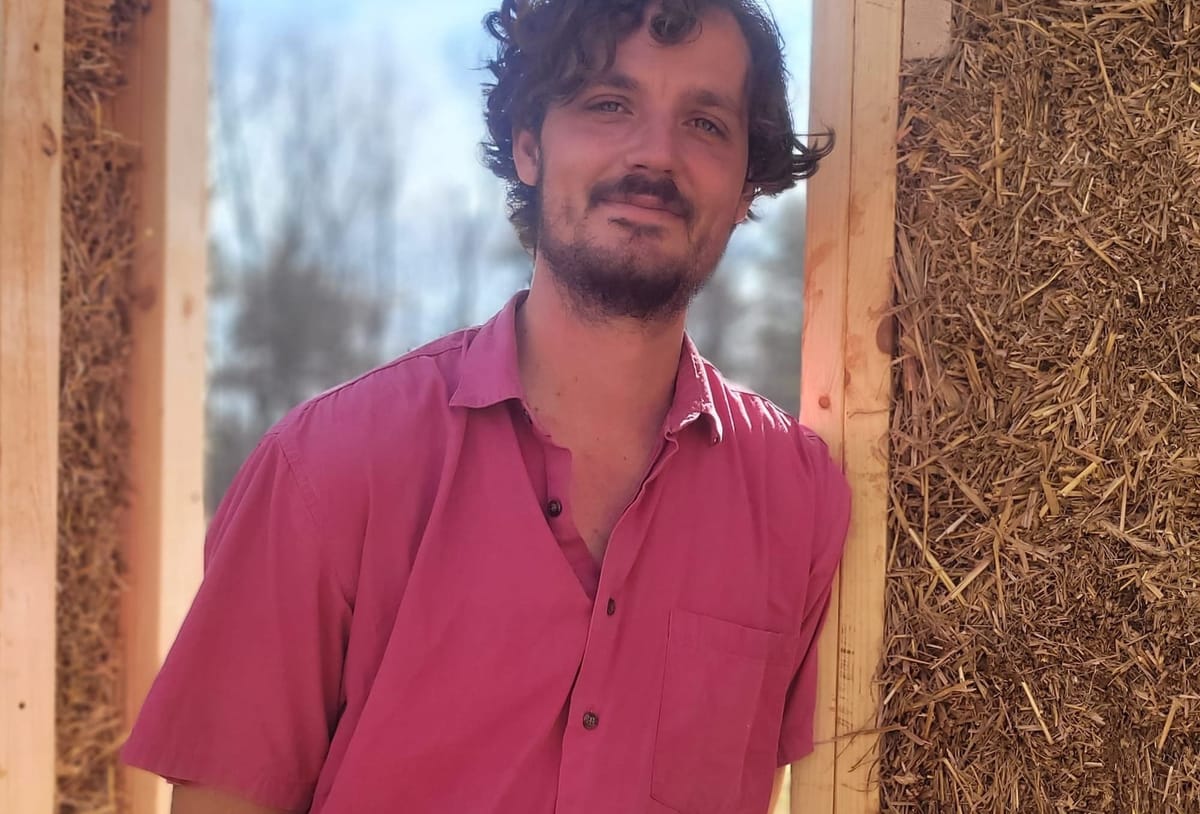
Saucha Atma Ananda, a local contractor who has worked in and around Floyd County for the past six years, is looking to change the way that people think of constructing a new home through the use of natural building materials, including straw bale insulation.
In 2025, Ananda and other local experts joined in a discussion about natural building options at the Jessie Peterman Memorial Library. While there were many types of natural building materials discussed during the event, Ananda chose to focus on compressed straw as a primary building material in his projects at Natural Resource Construction (NRC) because “a house in Arizona ought to look different from a house in Floyd because our conditions are different."
He explained, "We're building with straw in this county because we believe it is an excellent insulator" that is competitive with insulation used in "higher-end, more energy efficient" homes "without leaning on the types of glues and highly processed components" often used in construction. Plus, he said, "We know it's locally available at a good cost point.”
The old school building converted into three floors of almost all types of fabrics available, and craft supplies! Plus - an extra building of upholstery fabrics and supplies!
220 N. Locust St., Floyd VA
(540) 745-4561
sfabrics@swva.net
Ananda joked about the Big Bad Wolf blowing down the straw house and referred to an explanation on his website: “Contrary to the popular wisdom of nursery rhymes, a straw house will not blow down. When built properly, it will not burn, will not rot, or be rodent-infested. Our straw houses will outperform traditional stick-built houses on energy efficiency, and our attention to detail and design will provide people with housing that is more than worth the investment.”
Ananda’s shift toward natural building materials also came from a deeper desire to rethink how homes impact both people and the planet. “I want to use materials that are healthy for the body and healthy for the planet,” he said. “Historically," he noted, "homes were built with local resources because global supply chains didn’t exist. Modern construction often relies on heavily processed materials and chemical adhesives. Straw bale construction returns to a simpler philosophy. Our structures should be built and designed for the environment that we live in."
Call us today to schedule (540) 235-3095
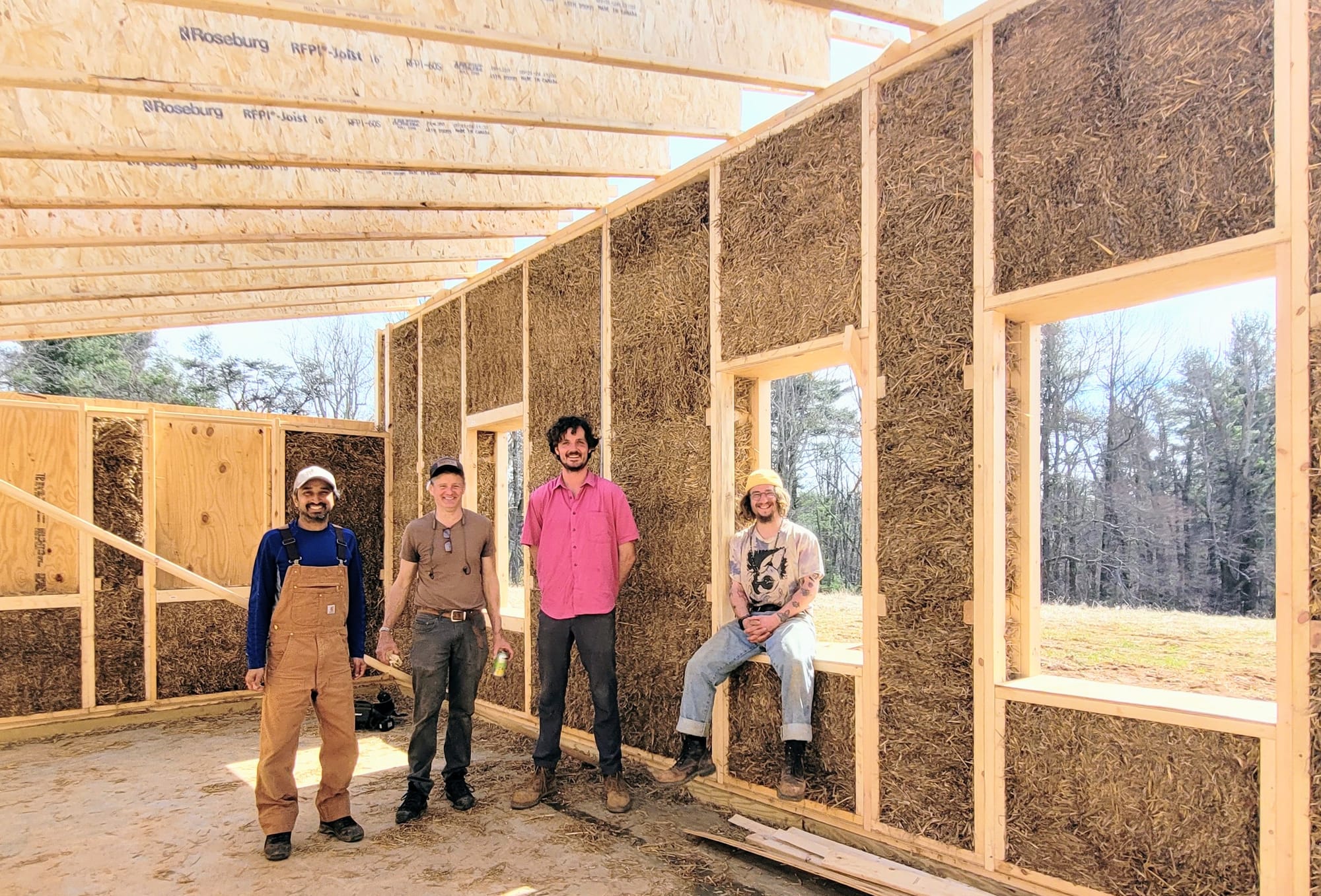
The process of manufacturing a straw bale structure starts off very differently than that of a traditionally framed home, and it starts with finding local, unsprayed straw bales.
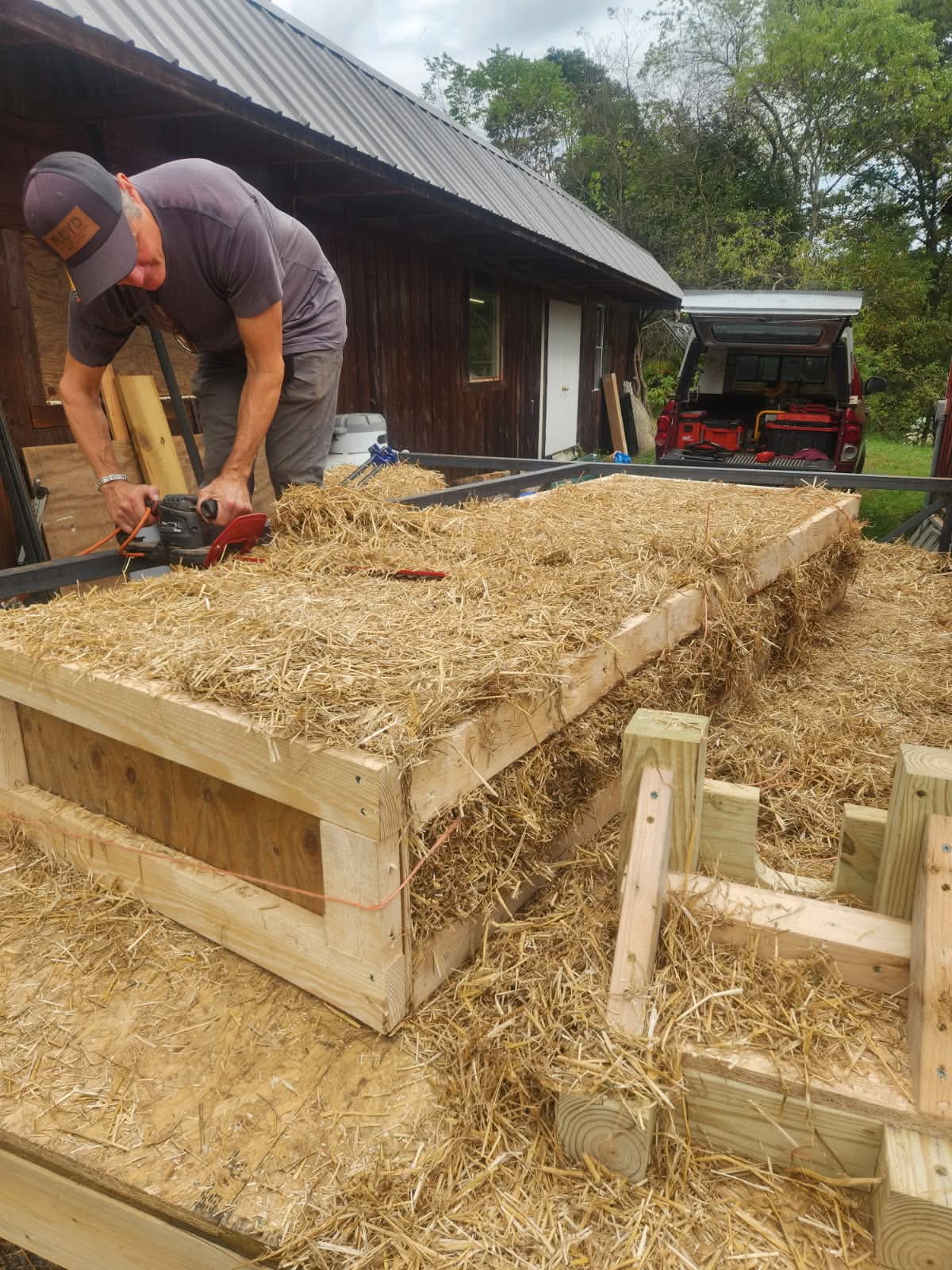
Once the materials are acquired, Saucha and his crew load the hay into a steel frame hydraulic or pneumatic press. This machine is an important part of the process to ensure panels are square, firm, and without variation in quality. According to Ananda's website, "Panels are then shaved of protruding straw on the manufacturing table. When completed these panels are 14 inches thick, 3 feet wide, and 8 feet tall."
Creating a proper frame out of the structure of these panels is just the beginning. According to Ananda, it's important that the system stays "vapor open," which means it isn't wrapped in plastic but in an "air barrier" to ensure that there's no air leaks into the straw or into the house.
His crew then installs a rain screen, which “allows for a separation between the external sheathing and the siding, and then we do siding. And so all that makes a pretty bulletproof assembly for a wet climate..." Ananda noted that the multi-layered protection is vital to crating a long-term, safe home.
Anada explains on his website that “one of the biggest threats to any home, including straw bale homes in our region (Appalachian Mountains) is moisture. Moisture in a home can cause mold, rot, and eventually building failure. It is the most important factor to consider in house design, and we take that very seriously. Properly managing moisture requires a combination of good design and proper detailing. The design includes good roof overhangs, grading away from the home, proper flashing and sealing, considering local elements like prevailing winds, sunlight, and groundwater.”
Ananda added, "The difference between a moldy house and a healthy house is thoughtful construction."
The assembled straw paneled walls can be married with any conventional roofing system “just as long as the building science is adhered to thoroughly throughout the building process.” Ananda noted that “eventually, we will be offering roof and floor panels. We're moving into our manufacturing facility this month.”
We offer locally sourced, insect and rot resistant hemlock, and lots of other species for just about any project.
We also can provide firewood, kindling, mulch, sawdust, and shavings.
Inside we produce paneling and flooring in various, often rustic local woods.
Come by or call Stacy
276-692-8754
After the framing and roof is completed, the installed straw walls are tested for moisture again. Ananda does this to confirm that it is safe to complete the interior walls, which now can be finished with any variety of options.
“Once your walls are up and secure you can go either traditional finishes like drywall or wood cladding, or you can go more natural finishes like lime or earth plaster," Ananda said.
Although Ananda and his crew are currently focused on the structural aspects of natural building through NRC, with a Class A contractor's license, Ananda “can fully manage the entire construction process.” He explained that he is also open to “partnering with people if they just want us to take responsibility for giving them a dried-in shell, or a sided and roofed shell... We're also happy to fully supervise the whole construction process from design to turnkey.”
Once completed, one of the most notable benefits of compressed straw panels is their insulation performance. The 14 inches of dense straw provides approximately R-35 insulation, which creates what Ananda describes as a “continuous thermal blanket around the building.”
To maintain efficiency, according to industry standards the roofs are typically insulated at even higher levels. “In an R-35 wall system like this, it would be ideal to have R-60 in the roof,” he said. “That way, the entire thermal envelope maintains that same high level of efficiency.”
The result is a home that requires very little energy to heat or cool. “On the job site we joke that you could heat it with a candle," Ananda said.
Highly insulated homes offer more than just lower heating bills. “When you live in a well-insulated house, you don’t feel extreme cold or extreme heat the same way,” Ananda noted, but the benefits go deeper than comfort. By choosing to avoid synthetic materials and maintaining vapor-open wall systems, the homes can also offer better indoor air quality.
“We’re not creating a Tupperware container,” he says. “Think of the difference between a polyester shirt and a cotton shirt.”
Straw walls also provide remarkable sound insulation. “If you made a cave out of straw bales,” Ananda said, “you’d have a hard time hearing what’s going on outside.”
He further explained, “You've got energy savings, you've got sound insulation, but also you have very, very high fire resistance, which is often surprising to people. ”
Many people initially worry and have a concern about the fire safety of straw homes. However, compressed straw behaves very differently from loose straw. According to Ananda, professional fire tests have found that “straw walls can withstand 1,000-degree temperature for a 90-minute period, with no combustion, minimal smoking, and heat transfer."
Ananda said that NRC will also be doing “independent fire testing for our straw bales, and we'll be posting videos about that to demonstrate that." He said the process has "been subjected to the same tests that a regular wall assembly has been in order to get into the code book, and they've outperformed those assemblies, even without plaster.”
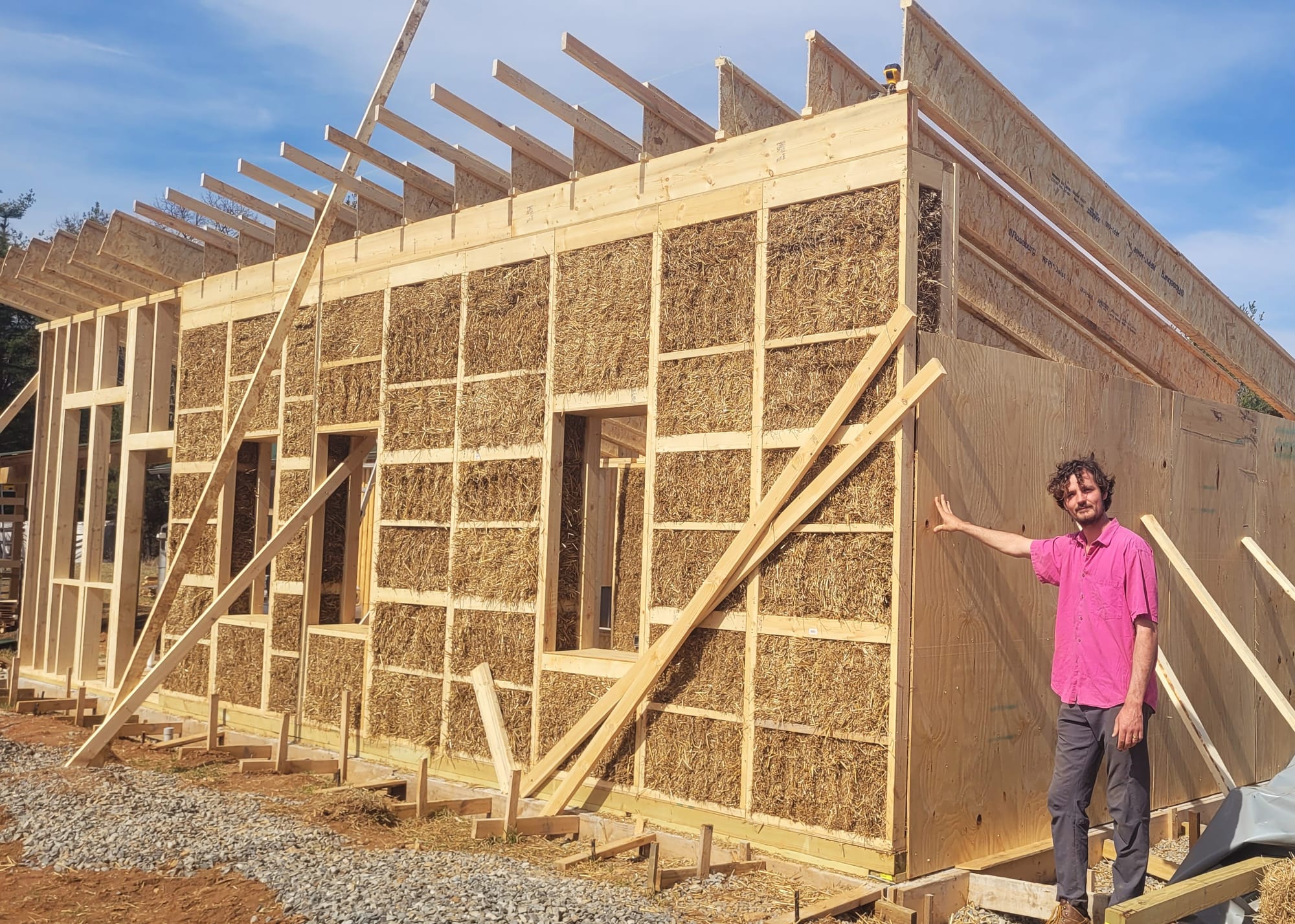
Ananda currently manufactures individual sections of walls in his climate controlled warehouse, he said. "Then we ship those to the building site and then we're able to assemble them in a much shorter time than typical onsite construction normally takes... We could get the walls up and insulation up in just a day on site.”
Here at the Bread Basket we are here for all your baked goods for the Holiday season: Pies, Sweet Bread, Cakes, Cookies and Sourdough Bread, Trays of Meat & Cheese, Cookies, and Sandwiches are prepared fresh made-to-order for each party. Bring this Ad in for a free loaf of bread for each 2 lb of deli products you buy. Call 540-745-5382 to place specials and orders-to-go.
Ananda practices what he builds. After moving into his own straw bale house, he experienced the system’s benefits firsthand during one of the coldest winters in recent years.
“Oh, it's amazing," he said. "We had, like, the coldest winter in at least six years this year. I mean Floyd Group was flooded with burst pipes, and my temperature didn't drop below 62 in my house. I only heated with a wood stove. We have so much thermal mass, if we light a fire once a day, the temperature stays between 65 and 72, it's very slow to drop.
When thinking about the future of homebuilding Ananda has high hopes for using straw bales as a sustainable option. “I think that there is a large percentage of Floyd residents who are already ideologically geared toward natural building... We have certain things to prove in terms of viability and making sure we can answer people's concerns. But it's very much our hope that we'll be building many, many straw bale homes in Floyd County and surrounding counties in the coming years.”
If you want to learn more about natural building with straw, contact Ananda by calling (540) 988-2098 or emailing contact@nrcofficial.com. Visit www.nrcofficial.com to learn more.