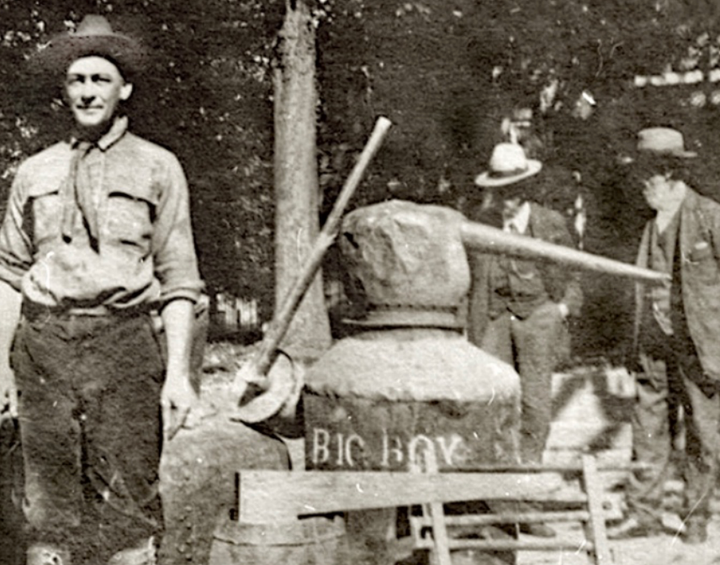
Will today’s youth be only passengers on Spaceship Earth?
Earth Day didn’t start as a celebration. It started as a reckoning. Have we forgotten why?
Earth Day Perspective: 56 Years Ago — and 50 Years Ahead
None of the students I spoke to recently could tell me the year of the first Earth Day. It was 1970. Some of their parents weren’t even born yet. Those young people had no historical context of the event, had no sense of what led up to that important day.
And yet, it was largely the energy and passion and concern of people their age 56 years ago that propelled Earth Day into a global event now celebrated every year in more than 100 countries.
The roots of passion and zeal that lead to that first April 22 event were many. Rivers were catching on fire from the volume of volatile chemicals dumped into them; downtown buildings were invisible in the ozone and nitrous haze that made them look like today’s China; and birds were dying in large numbers because—as Rachel Carson sounded the alarm— we were very wrong about the long-term effects of man-made chemicals in the air, soil, and water.
And that was not okay. We became convinced that our presence here was making the planet sick. It was time to change our ways, and we did so with a level of commitment and focus that really made a difference. Fifty years from now, they will be my age. What will their Earth be like? Will their generation take the reins or let business-as-usual take its course? Did they even know the deeper issues behind the obvious failures like Love Canal, Deep Water Horizon, or ocean dead zones?
The level of awareness was mixed in that class of freshmen to seniors and hard to judge from the front of the classroom. Mostly, I’d say they are “younger” than their age peers from 1970. They may have the facts, but they aren’t looking ahead. They aren't evaluating the costs their choices today will make in the lives and environments of their kids and grandkids.
"Flower power" … "Tree huggers" … "Back to the land."
The clichéd phrases of those days seem silly or trite or eccentric because they’ve been played that way by the media for the most part. They were "the stoner generation," a bunch of "idealistic hippies" who needed to find work. I will have to confess that in 1970 I didn’t get it. I was not an activist. I was generally oblivious to environmental issues until that year. But now I look back and have great respect for the values at the root of these phrases that describe the Earth Day generation.
Those “movements” expressed a kind of generational repentance to repair broken relationships to nature, the planet, and each other. We had not honored the Earth as the material source of life and our well-being, but treated it in ways that were making it sick. We had lost the sense of wonder and reverence for the life we share with all things. We had become part of the machinery that was eating us up.
Many in that generation did more than wear flowers in their hair. They came back to the land and rejected the systemic evils of the consumer economy that treated trees and people as commodities.

It was a genuine, future-changing phenomenon, and Floyd County is different today because of the tide of change represented by that first Earth Day.
The influx of young people in the '70s into Floyd consisted of people — potters, farmers, painters, herbalists, and poets — who wanted to use their hands in a place not sold out to or uglified by fast-lane busyness — a place where the greatest goods were not profit and efficiency; a place where they could practice their farming, their arts or crafts, and have the worth of their lives measured by their relationship with the soil, the mountains, the people around them.
A telling fact: As of the 2020 Census period, Floyd County remained among the lowest-income counties in Virginia, ranking roughly in the bottom 10 statewide. And while it has not been measured, I would be willing to bet that, if you could measure the general sense of well-being, our county may have one of the highest ratings in Virginia when measured by environment, social cohesion, and quality of life — a state of mind and relationship with place brought about in no small degree by those Earth Day pioneers.

Our store offers a selection of lumber, roofing material, insulation, plumbing fixtures, electrical components, and conveniently located five minutes outside the town of Floyd.
And so there are lessons learned from Earth Day in the decade after that event that have been forgotten, obscured by the engines of empire, commerce, and wealth-generation. They can and they must be re-learned.
It is today’s young people who must hug trees, wear metaphorical flowers in their hair, honor the Earth, and come back to the land in their attitudes, their lifestyles, and their politics if there is to be any hope for a high level of perceived well-being in their grandchildren’s generation.
This essay was first published @Medium.com on April 20, 2014, and updated for Floyd Times.
Fred First is a published writer and former Floyd County resident who documented local happenings and musings on "Fragments from Floyd." He holds masters degrees in vertebrate zoology and physical therapy, and has been a biology teacher and physical therapist by profession. He currently blogs at Substack.
More of his writings can be found at:
https://fragmentsfromfloyd.com/stuff/
https://medium.com/@fred1st
https://substack.com/@fredfirst
Southwestern Virginia’s premier source for hemp products. From edibles and tinctures to topicals and accessories, we provide trusted, high-quality options for both wellness and relaxation. Visit our retail locations in Downtown Floyd, Roanoke (Wasena neighborhood) or shop online today!