Backstories and Backyards: 'Brick by Brick'
This month's column time-travels by way of an 1851 handmade brick and a set of 20th century bricks carved into dollhouse furniture from the Old Church Gallery cultural arts collections.
"Backstories and Backyards" column looks back into the stories behind everyday objects, connecting each item with the people, places, and events of different eras in Floyd County history. This month's column time-travels by way of an 1851 handmade brick and a set of 20th century bricks carved into dollhouse furniture from the Old Church Gallery cultural arts collections.
The mid-late 19th century saw an explosion of building in the Town of Floyd. Sparked by industrial advances and an entrepreneurial spirit, the town center became a hub of activity. Anchoring this development was the 1840s arrival of an Irish-born brick mason, Henry Dillon, whose skills most likely seeded generations of brick masons here.
Of Dillon's masonry work still seen in Floyd are: Glenanna, the 1849 Tazewell Headen house on West Main; nearby Boxwood Gardens, Dillon's 1851 home; and the 1850 Floyd Presbyterian Church on East Main. These buildings are significant contributors to the Town of Floyd’s National Register of Historic Places district. Henry Dillon also completed the former 1847 brick Jacksonville Academy; Aspen Hall, the 1846 boyhood home of Robley Evans; and the 1851 Floyd Courthouse, where the humble brick that inspired this column originated.

From custom homes and renovations to decks and additions, Esensten Construction delivers dependable craftsmanship across Floyd and the surrounding areas. Locally owned, Class A licensed, and built on integrity—every project is done right, start to finish. Call today to discuss your project.
540-232-9534
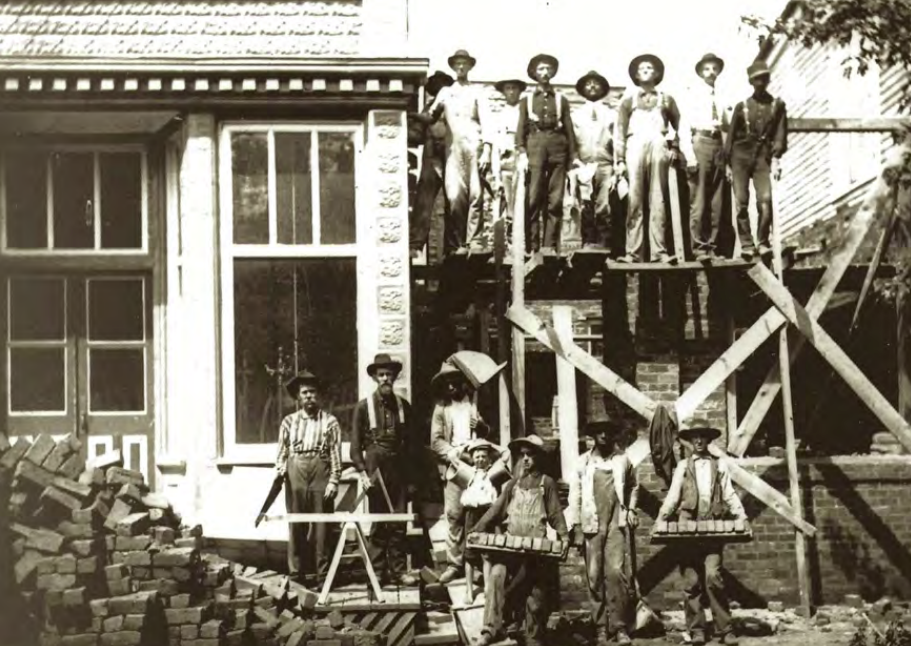
Henry Dillon's masonry skills likely extended to the Earles family of brick masons. Gordon Cloyd Earles (1825-1873), is listed in both the 1850 and 1860 US Census as a brick mason. With those early dates, Gordon likely worked on some of Henry Dillon's projects, including the 1851 Greek Revival-style Floyd County Courthouse. The masonry trade was carried on by Gordon's younger brother, Henry Harrison Earles, b. 1841, shown above, and, for a time, by Henry's sons, Albert Gordon and Charles Emet Earles.
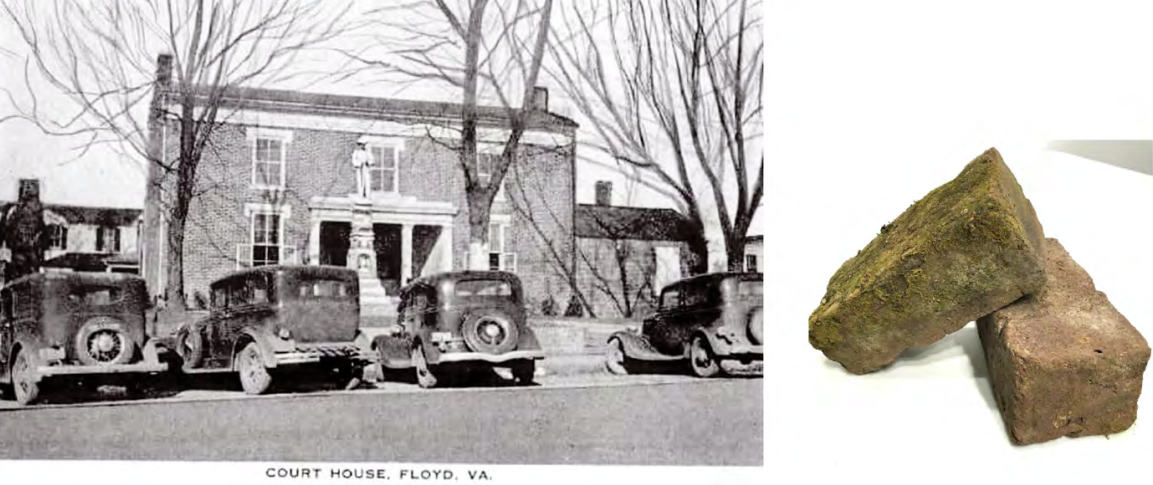
Brickmaking in rural areas depended on the availability of surface or superficial clay deposits. Floyd County's floodplains were a limited source, as were deposits of weathered gneiss and shale. Clay, by itself, is a mixture of various fine mineral particles created by prehistoric weathering. Loam, a mixture of clay, sand, and silt, would have been secured for brickmaking. Composition and color can vary from place to place, depending on inclusions. Clay particles have a mica-like platelet structure, which allows the material to feel slippery when wet. Early rural brickmakers would have to judge the deposit's brickmaking potential, amounts of impurities, and color for quality. The 1851 bricks shown here have a blockier shape, rough texture, and are low-fired compared to today's.

Your Best Move
Craig Chancellor
126 North Locust St.
Floyd, VA, 24091
(540) 523-1300
Each Office Independently Owned and Operated.
We are here to help you with all your real estate needs.
Now providing property management services.
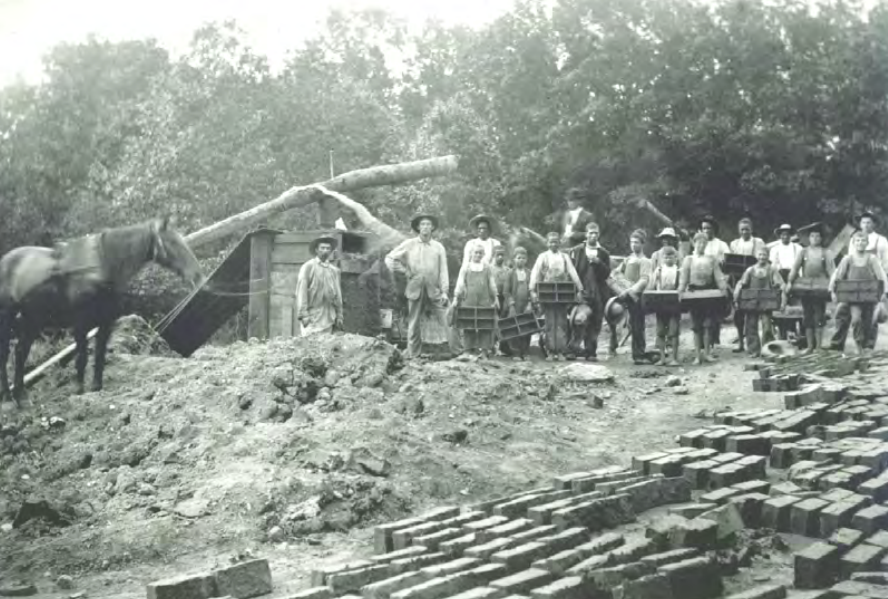
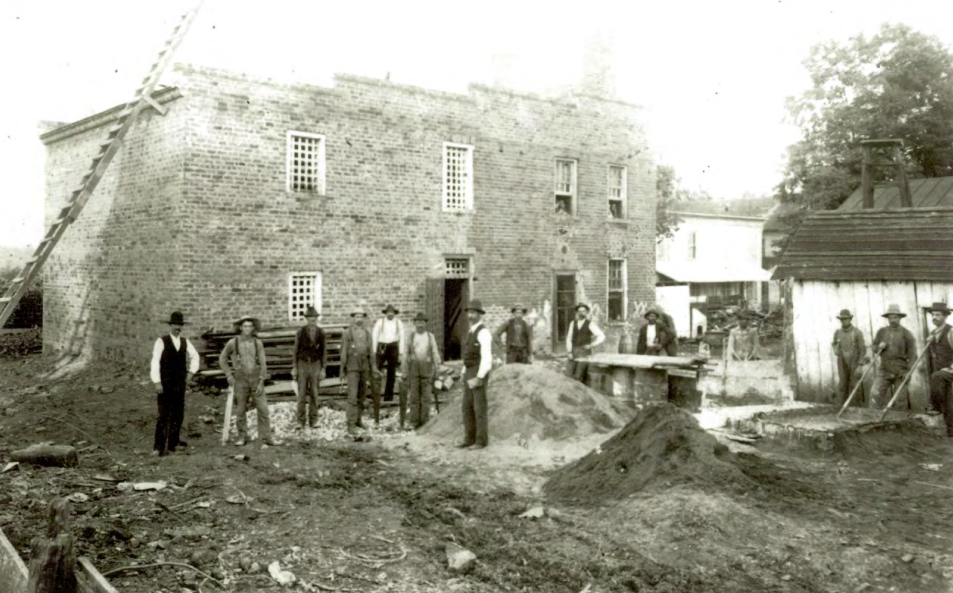
The early brickmaking process was long and labored. Once the clay was dug, it required tempering, by weather or time, often left in a pile to overwinter. In the Spring, the clay would be mixed with water and sand using a horse-turned pug mill, as pictured here in the Earles operation in Floyd. The center post in the pug mill turned paddles or blades in the mixture. The sand kept shrinkage to a minimum. Wooden molds were hand-packed with clay, leveled off, and then emptied on the ground to allow drying. And, it wasn't unusual to find paw prints imprinted on a wet brick.
Brickmaking machinery began to appear in urban areas prior to the Civil War. But it wasn't until the 1903 development of the Brinton Arsenic Mine near Simpsons, which required over 350,000 bricks manufactured on site, that machine-molded brick became common in Floyd County. The Brinton operation had just "burned two brick kilns" according to a July, 1903, Floyd Press notice, in preparation for building a brick furnace for volatilizing the raw mineral into a commercial product. The same news item described the clearing of forest land for cord wood.
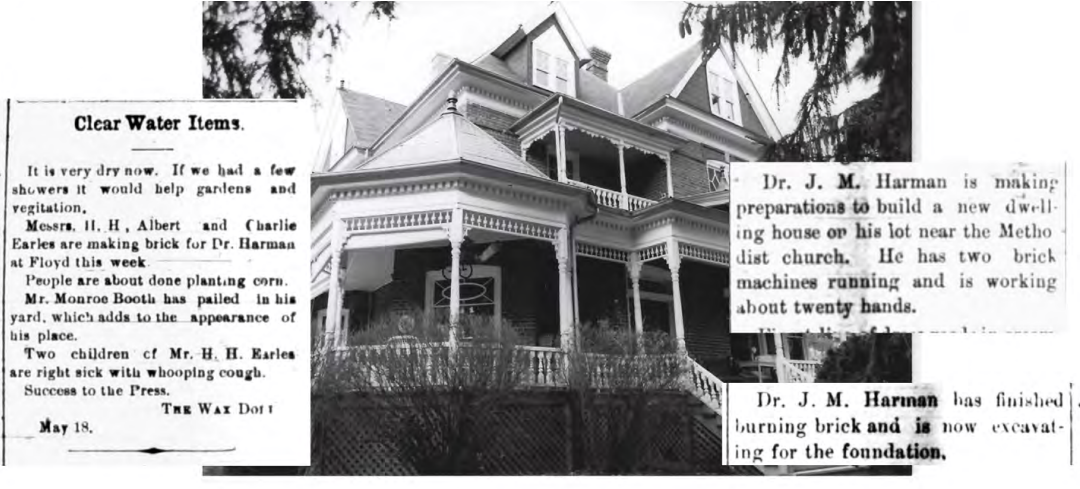
Henry Harrison Earles and sons, Charles Earles and Albert Earles, manufactured brick by machine for Dr. Harman's new home and office. The house plan was from a mail order company and came with prefabricated parts. The plans were altered to include interior brick walls. A May, 1903, Floyd Press report noted: "He has two brick machines running and is working about twenty hands." We know from oral history that the temporary brick kiln was set up in the current Food Lion lot. The field kiln or clamp was burned using hardwood stoked into parallel fire channels at the base. The dry brick was first corbelled and stacked over the tunnels into a mountain of bricks which was then daubed with mud to seal the exterior. It was a tricky operation that required some skill, and days to fire, as the intense heat needed to be hot enough to vitrify or harden most of the unfired bricks.

Family-owned HVAC installation and services.
25 years of experience. Committed to excellence.
Financing available with approved credit.
540-745-4912
436 Floyd HWY S
In addition to the Earles family, Floyd County brick masons listed in the 1870 U.S. Census included Samuel Howell b. 1835, John Price b 1800, James Palmer b. 1800, William C. Booth b. 1831, Eden R. Palmer b abt. 1828, Joseph R. Palmer b. 1831, and Thomas Backner b. 1818. The 1880 census added Robert Williams b. 1834, Alexander Cannaday b. 1851, and Thomas Jenning b. 1827. Earlier 1860 lists included Harden R. Hall b. 1806, and Jonathan Starr b. 1825.
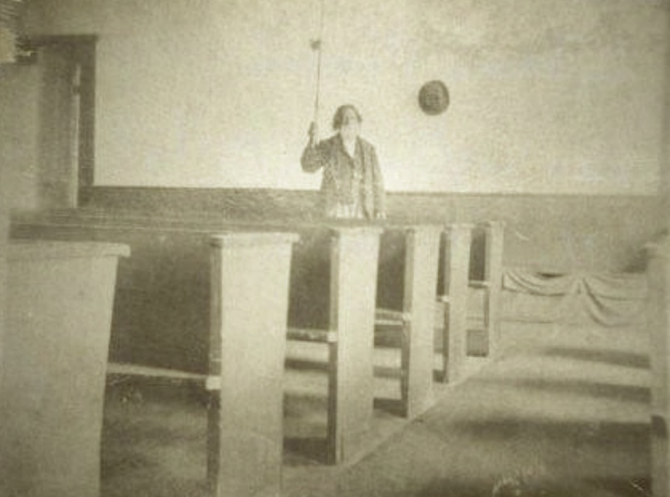
Brick mason Samuel Howell, born 1838 into enslavement in Henry County, was brought to Jacksonville (now Floyd) sometime after by either Samuel Evans or Pleasant Howell. Dr. Samuel Evans owned Aspen Hall, built in 1846 by Henry Dillon, which stood beside the newly built brick Presbyterian Church. After Evans' death in 1856, the property was purchased by Pleasant Howell. Becoming a brick mason after emancipation, Samuel Howell might have learned the bricklaying trade as a youth, since, as evidenced in several brickyard photos here, helpers started at a young age. A recent Floyd County Historical Society program detailed the role of Black labor in brickmaking for Henry Dillon's 1850 Presbyterian Church and others. An 1866 entry shows Samuel married to Sarah Akers, and, notably, in 1870 he was officially listed as a brick mason by trade.

Mark J. Harris
Floyd County Farm Bureau
(540) 745-2021
335 E. Oxford St.
Floyd VA 24091
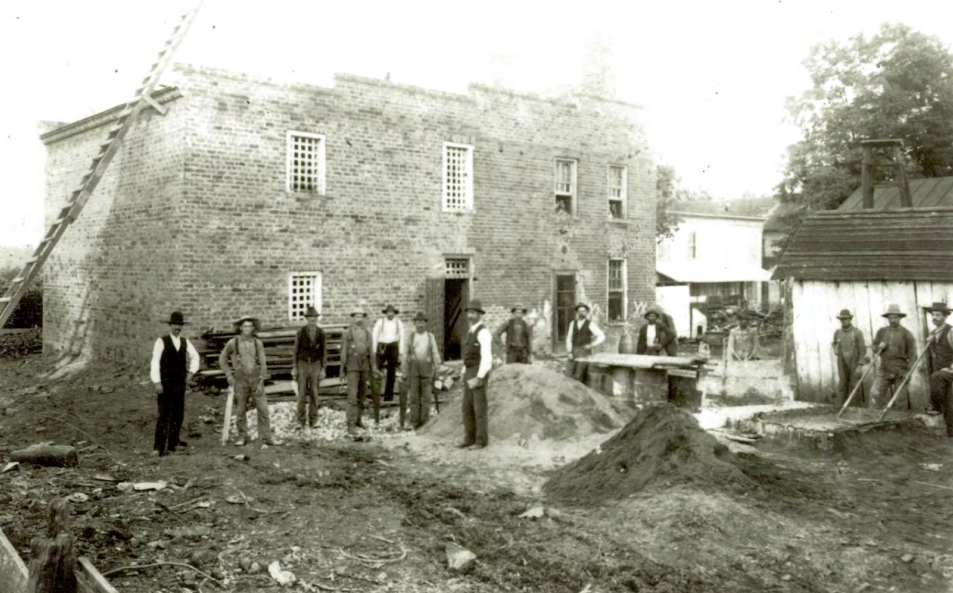
More modern, manufactured bricks were generally of higher quality and uniformity. By the early 20th century, E.F. Strong, Creed W. Price, and Wise Hayden, Jr., practiced brick-laying skills, and a bit later, Wise's son Bill Hayden joined the trade as well. In their 2011 Floyd Story Center WWII-era series interview, Bill and Connie Hayden told me how that came to be:
William C. Hayden: "I went to bricklaying school, after I came out of the Navy. I stayed in Roanoke. I went to Booker T. Washington School, and I got married in '46, and I come back. I got leave, and I built up the home in ’48. Daddy was a bricklayer, too."
Kathleen Ingoldsby: "So, bricklaying school?"
Constance Hayden: "Yes, he went to Booker T. Washington Trade School for two years."
William C. Hayden: "After I finished bricklaying school, I came back to Floyd. So, I’ve been here all my life. I went to contract out with a contractor with brick, and I’ve been in Floyd ever since."

Twentieth century bricks came from factories, manufactured by the thousands, which is where Silas Hines Sutphin once worked, taking creative license to carve two sweet brick samples into children's toys.
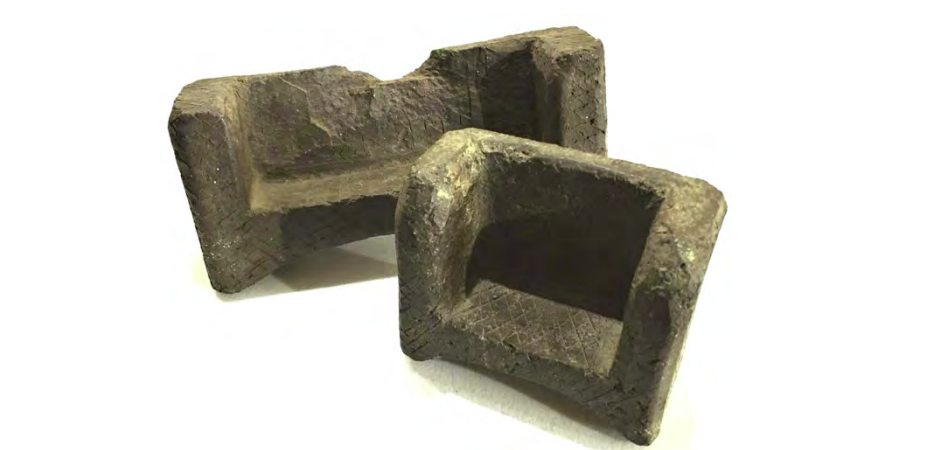
Silas Hines Sutphin was born in 1880 in Floyd County, but moved with his family to Illinois as a child. There he later found work as a teamster and as a laborer in a brickyard. This set of dollhouse furniture was made for his two great-nieces Helen and Ruth Sutphin, whose family lived on a farm in the Greasy Creek community near Willis. He fashioned the settee and chair out of common factory brick. Both pieces have rounded corners on the arms and bottoms curved to form feet. Mr. Sutphin even scratched a diamond upholstery pattern onto the surface.
Today, history would smile, as there are many kilns in Floyd County "burning" clay products. Floyd is home to over a dozen pottery studios, with many potters' kilns firing up a wealth of artistic and functional ware. Some fine examples of work by the 16 Hands craftspeople can be seen at the current Old Church Gallery exhibit, "Shaping and Turning." Malleable earthen clay has survived the test of time, its use dating from prehistoric vessels, to ancient Near East clay tablets, adobe dwellings, stoneware jugs, fine-porcelain, art pottery, and of course, the humble brick.
All Floyd Story Center interview excerpts are courtesy of Old Church Gallery in Floyd. The excerpts presented in this column represent a larger archive of over one hundred and twenty interviews, 1980s-2024, many recorded with both audio and video.

Our checking accounts are designed for how you bank every day, with convenient access and personal service from people you know right here in Floyd.