Governor declares State of Emergency to aid farmers facing hay shortage
In Floyd County specifically, hay yields were down 45% for the first cutting, according to Senior Floyd Extension Agent Jon Vest. He said, "Folks that made early hay (May cuttings) faired a bit better, and as the hay harvest extended into June, losses of up to 50% were reported."

Gov. Abigail Spanberger this week declared a State of Emergency to support Virginia farmers and producers in response to the statewide hay shortage caused by ongoing drought conditions.
Spanberger’s Executive Order 21 allows hay to be transported quickly and efficiently to farms across the Commonwealth by granting over-width exemption waivers to carriers transporting essential agricultural supplies of hay in any part of Virginia, accelerating feed delivery to farms and livestock producers, for a period of 30 days beginning Oct. 1.
According to the order, these waivers will help make sure farms can maintain operations and protect livestock health as persistent drought conditions have caused a statewide hay shortfall of 500,000 tons. The declaration also provides access to emergency funding, activates price gouging protections, and authorizes additional measures if necessary.
“The drought has placed real pressure on livestock producers across Virginia,” said Spanberger. “This waiver will help us move critical hay resources more quickly so farms can prepare for the months ahead, feed livestock, and sustain their operations.”
Mark J. Harris
Floyd County Farm Bureau
(540) 745-2021
335 E. Oxford St.
Floyd VA 24091

At Edward Jones, we deliver candid guidance and personalized investment strategies to help you plan for and realize the possibilities of your future — for you, your family and generations to follow.
Persistent drought conditions have caused a 35% loss in hay yields statewide, with yield losses in some cases reaching 70%, according to the Virginia Cooperative Extension. In Floyd County specifically, hay yields were down 45% for the first cutting, according to Senior Floyd Extension Agent Jon Vest. He said, "Folks that made early hay (May cuttings) faired a bit better, and as the hay harvest extended into June, losses of up to 50% were reported."
Additionally, from the beginning of the grazing season through June, farmers had to prematurely feed hay for at least 30 of those 90 days due to poor pasture conditions and inadequate forage resulting from drought. These circumstances have put local farmers in difficult positions, Vest said.
"Farmers are currently making decisions impacting herd numbers, and their anticipated feed needs..." he said. "Other farmers have already re-examined the need to reduce herd size or aggressively cull out older livestock that may be on the borderline of productive use."
Vest explained that second cuttings that have been completed are equivalent to a normal dry year, though farmers who have not yet completed their second cuttings could be impacted by the recent dry weather, which "will certainly impact their overall hay production again." He noted that this will cause many producers to look into options for purchasing hay from outside the area, meaning they will benefit from provisions of the Executive Order.

The Executive Order became effective on Sept. 16 and remains in effect for 45 days unless amended or rescinded. The 15-day period between the start of the Executive Order and the beginning of the over-width waiver will allow farmers time to source hay and transportation in order to maximize their use of the state-issued emergency waiver, which federal regulations limit to 30 days.
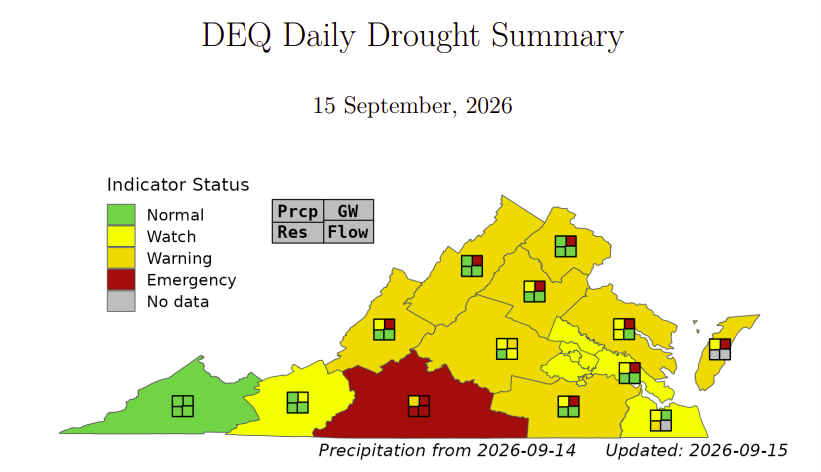
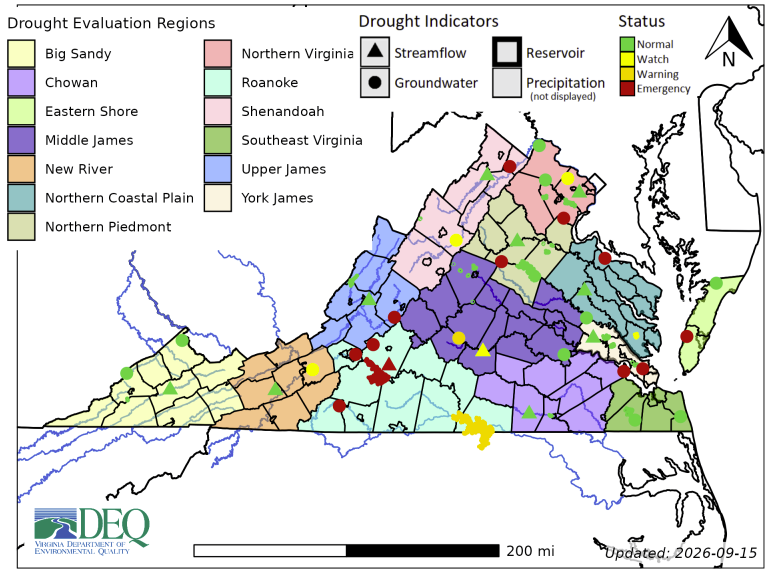
The Department of Environmental Quality’s Daily Drought Summary and Drought Evaluation Map from Sept. 15 states the New River Region, including Floyd County, is considered to be in drought Watch conditions. The Roanoke Region is in Emergency status, and the Big Sandy Region (far-Southwest Virginia) is currently experiencing Normal conditions.